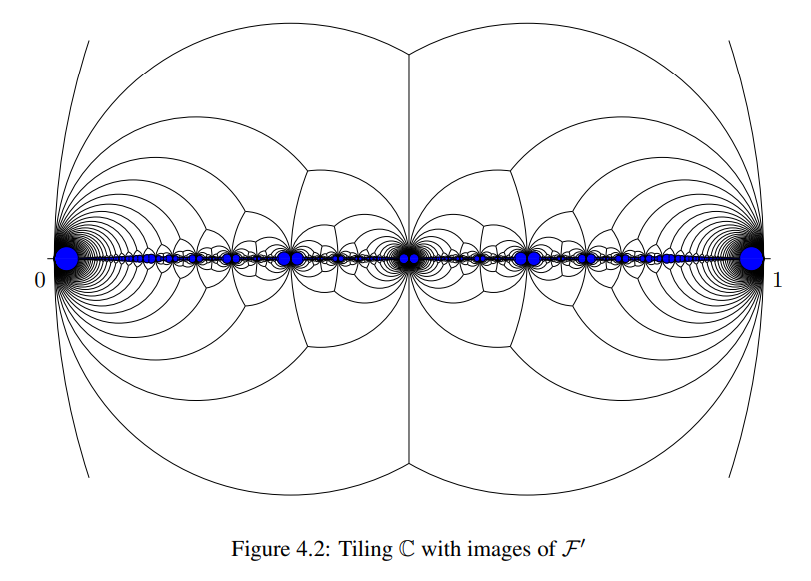
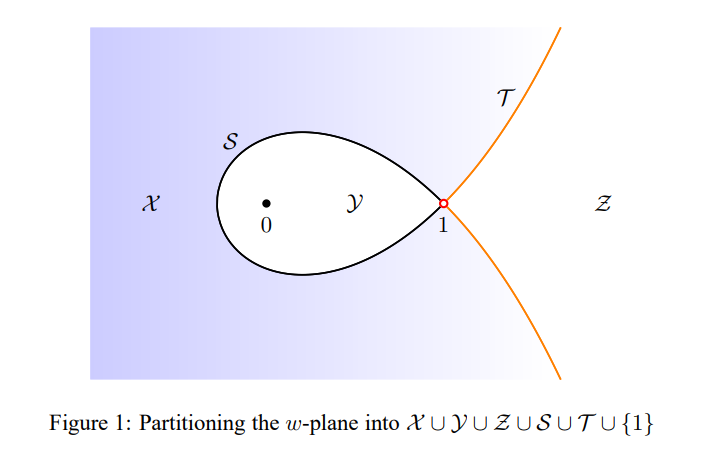
The new continued fractions in this paper give each region in the Figure a unique address.
Some figures from my papers
_____________________________
|
|
From: Integer continued
fractions for complex numbers, (2025)
arXiv The new continued fractions in this paper give each region in the Figure a unique address. |
| From: Topographs for binary quadratic forms and class numbers,
Mathematika
71 (2025),
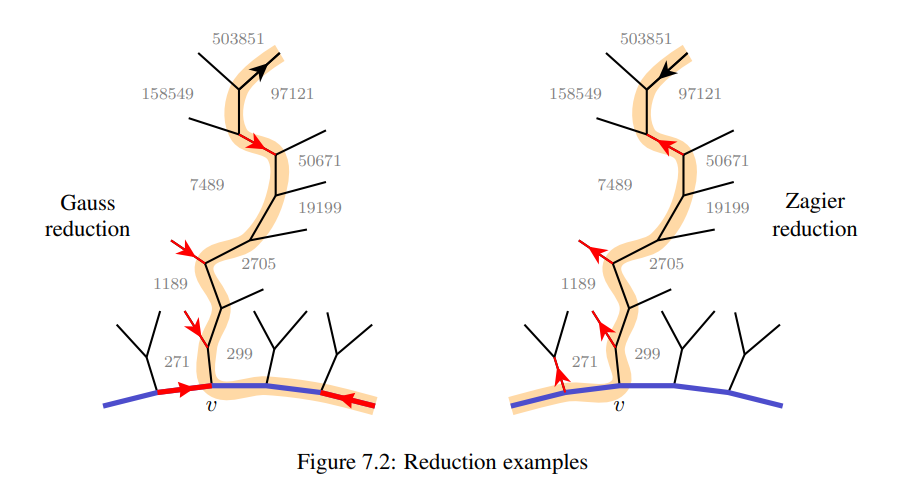
pdf How methods of reducing quadratic forms look on Conway's topographs. |
 |
 |
From:
Symmetric functions and a natural framework for combinatorial and number
theoretic sequences,
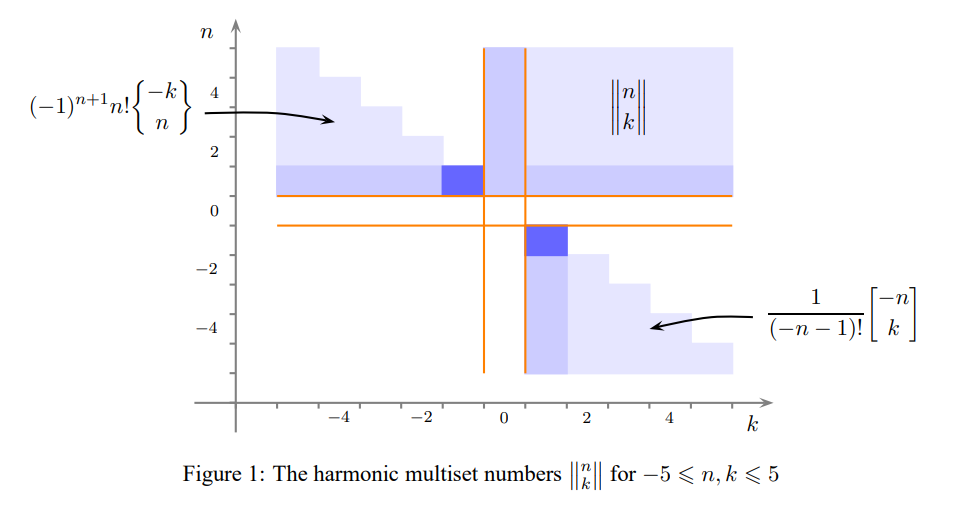
Res. Number Theory 9 (2023), pdf These new harmonic multiset numbers include both kinds of Stirling numbers as special cases. |
From:
Stirling's approximation and a hidden link between two of Ramanujan's
approximations,
J. Combin. Theory
Ser A. 197 (2023), pdf
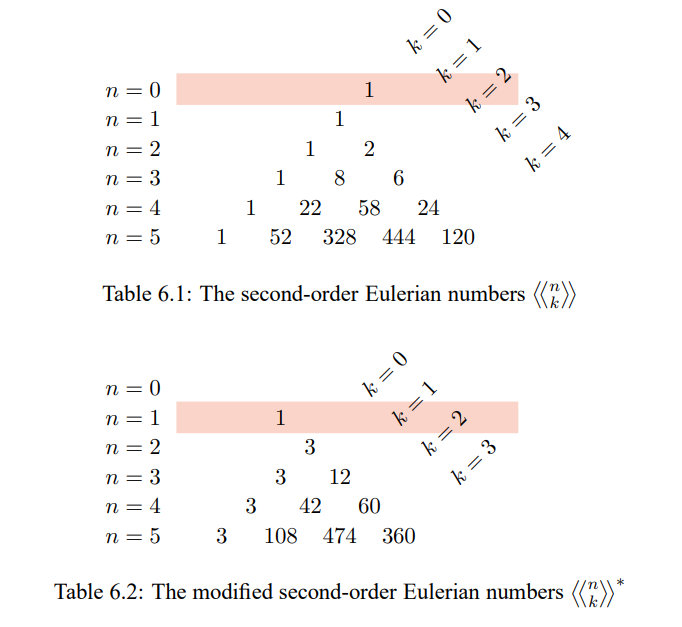
These modified second-order Eulerian numbers satisfy the same recurrence
but with different initial conditions. They are used to describe in
detail two asymptotic expansions of Ramanujan.
 |
From:
Ramanujan's approximation to the exponential function and
generalizations,
Ramanujan
J. 62 (2023), pdf A generalization of some asymptotic results of Ramanujan, Buckholtz and Knuth requires the Szego curve in the Figure. |
| From:
A generalization of the Riemann-Siegel formula,
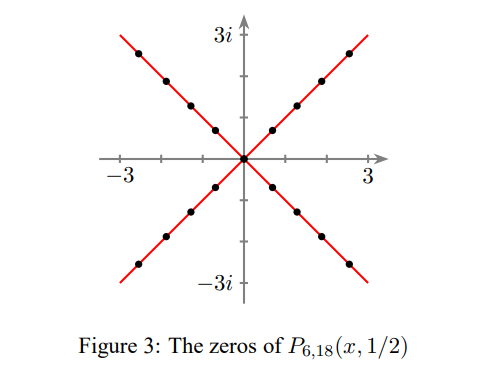
Math. Z. 303 (2023), pdf This work gives precise asymptotics for the Riemann zeta function in the critical strip. The zeros of the polynomials needed in the main formula also seem to line up. |
 |
 |
From:
Rademacher's conjecture and expansions at roots of unity of products
generating restricted partitions,
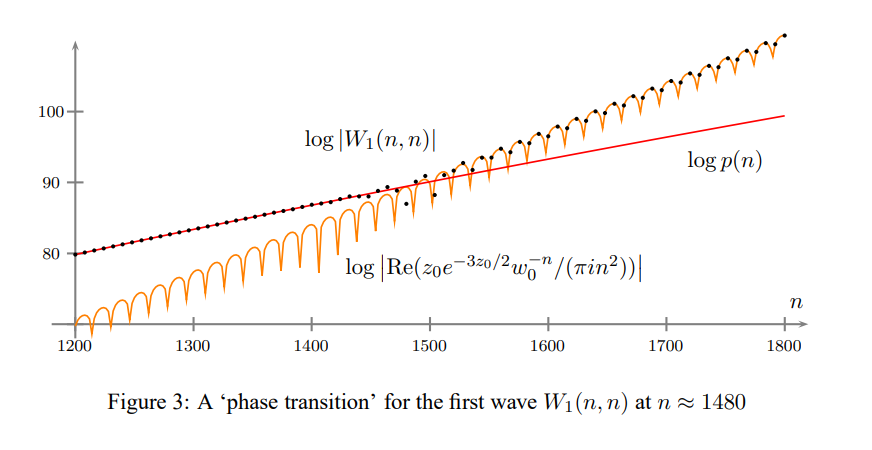
J. Number Theory 216 (2020), pdf The first Sylvester wave is initially a good approximation to the partition function, but then goes its own way. |
| From:
A vertex and edge deletion game on graphs,
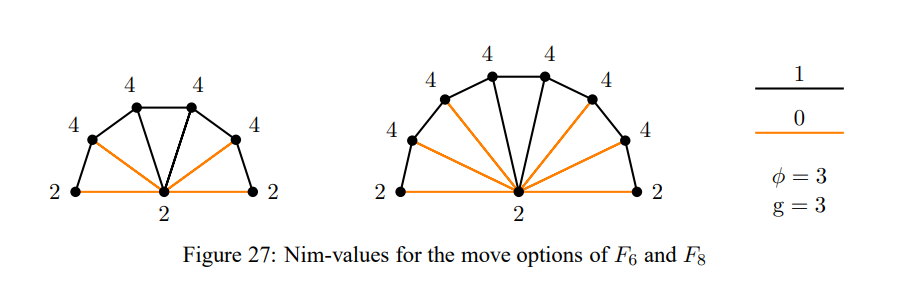
Integers 18 (2018), pdf Play this game on a graph: on your turn remove an edge or remove a vertex with all its incident edges. Take the last vertex to win. The nim-value 0 moves shown are winning. |
 |
 |
From:
Formulas for non-holomorphic Eisenstein series and for the Riemann zeta
function at odd integers,
Res. Number
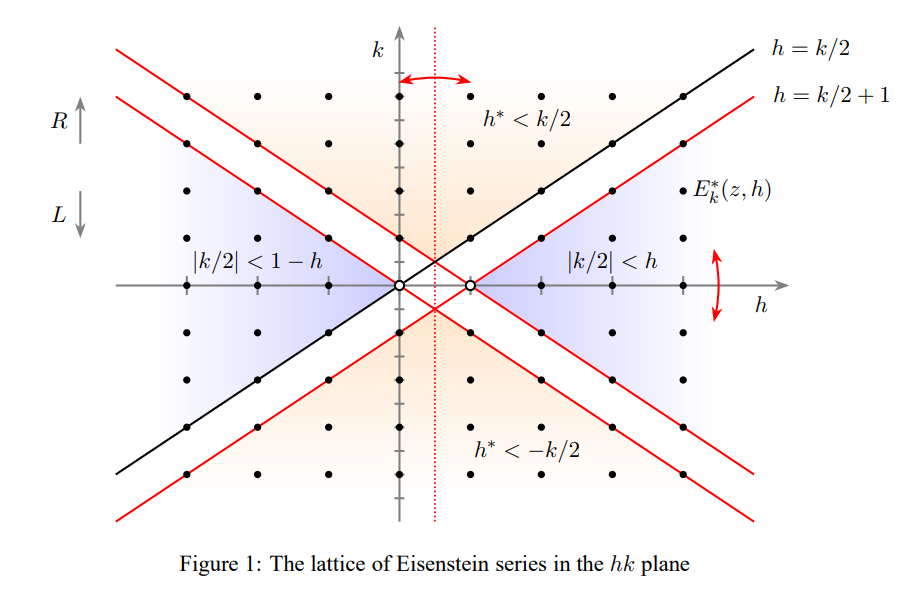
Theory 4 (2018), pdf This lattice of Eisenstein series naturally breaks into the four parts shown. |
|
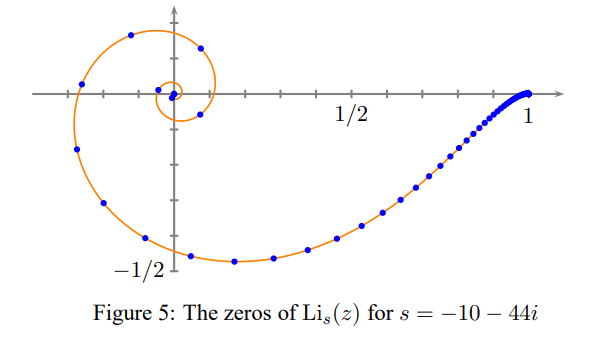
From: Zeros of the dilogarithm, Math. Comp. 85 (2016), pdf The zeros of some polylogarithms form spirals. |
 |
 |
From: Parabolic, Hyperbolic and Elliptic Poincare Series,
with O. Imamoglu, Acta Arithmetica 139,
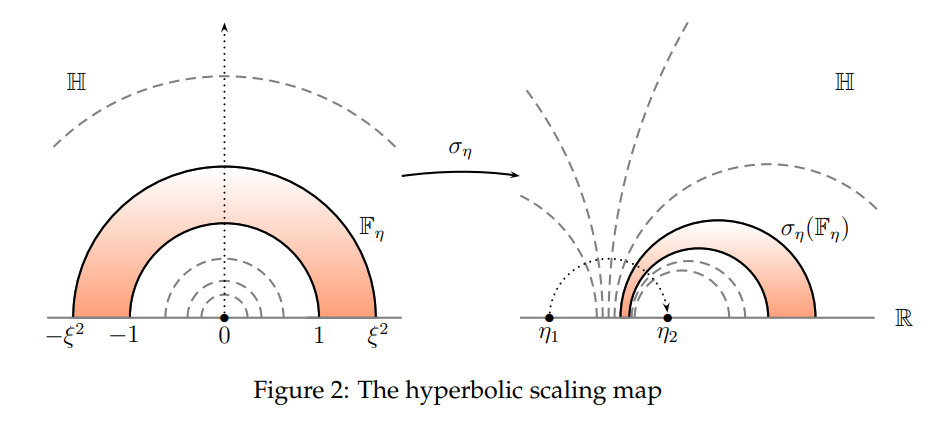
(2009), pdf How this scaling map works in the upper half plane. |